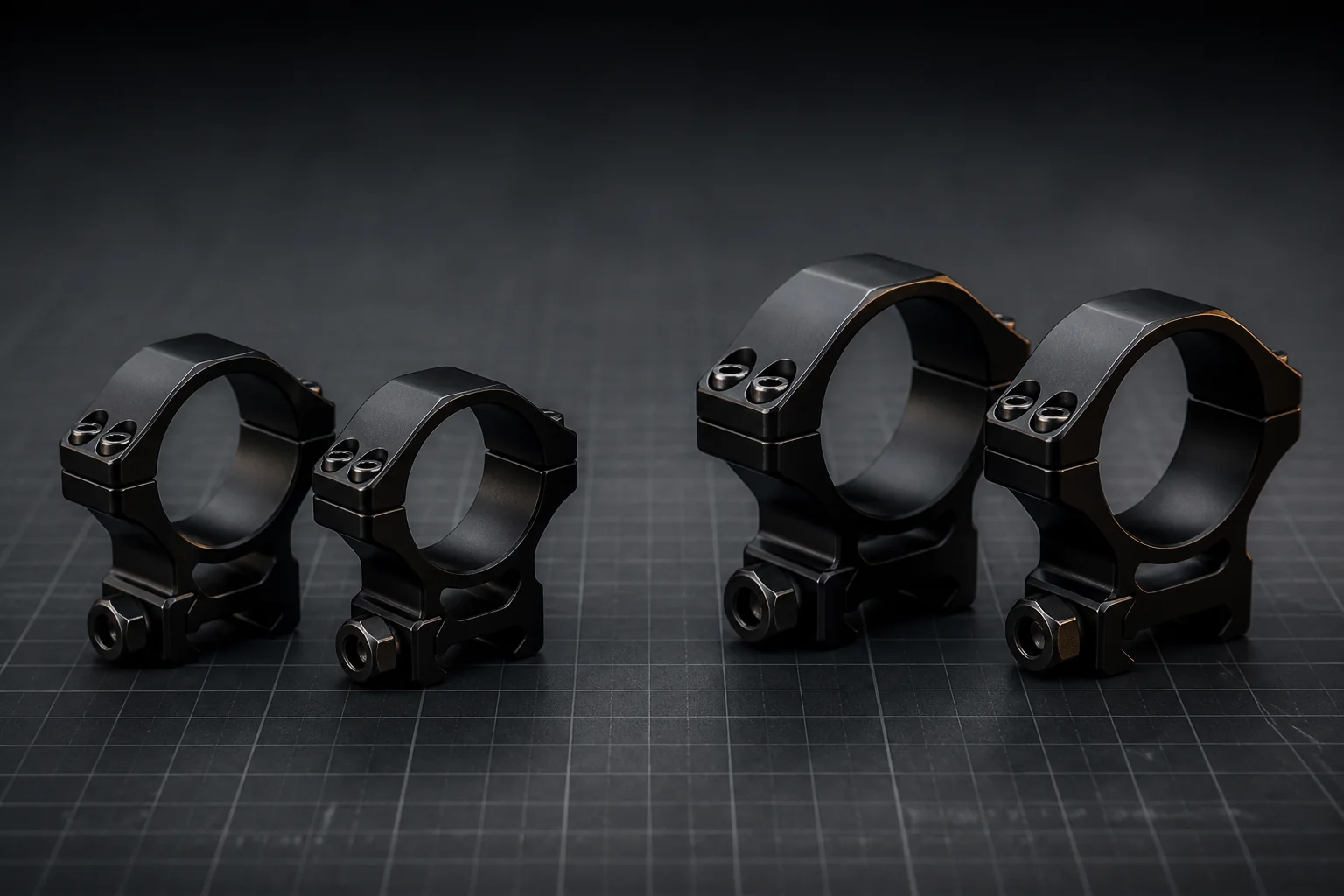
Choosing between 30mm and 34mm scope rings is one of the first specification decisions a B2B buyer makes when building an optic mounting stack. The tube diameter sets the envelope for objective bell size, elevation travel, and overall mass, and it ripples through ring height, rail choice, and repeatable zero. This guide walks procurement and product teams through the trade-offs so the right ring ships with the right optic.
What the number actually means
The millimeter figure refers to the main tube of the sight, not the objective lens. A 30mm tube has been the volume standard for years; a 34mm tube is the larger envelope favored on optics built for extended elevation adjustment and brighter, bigger objective assemblies. Both seat into rings of the matching inner diameter, and both rely on the same mounting discipline: square, level, and torqued to spec.
Weight and balance
A 34mm assembly is heavier at the front. That extra mass sits forward of the receiver, which changes balance and, on lightweight builds, can shift point of impact if the interface is not rock solid. A 30mm build stays lighter and is easier to balance on compact chassis. For distributor catalogs, stocking both lets you serve the high-adjustment long-range buyer and the weight-conscious buyer from one bracket program.
Ring height and clearance
Tube diameter drives ring height. A 34mm tube needs taller rings to clear the handguard and the objective bell; a 30mm tube often clears with a lower ring. Ring height changes cheek weld and eye relief, and it interacts directly with return-to-zero discipline (see our guide on scope ring height and return to zero). The rule of thumb: choose the lowest ring that gives full clearance, then verify with the optic in place.
Heavy-optic stability and material
Heavier front mass places more cantilever load on the mount. Material choice matters: aircraft-grade aluminum offers a strong, light base, while carbon-fiber composites cut weight for the same stiffness envelope (compare in our carbon-fiber vs aircraft-aluminum guide). For B2B programs, the specification should name the alloy or weave, the finish, and the torque range so every unit ships identical.
Rail interface and compatibility
Both ring families mount to the same rail standards – Picatinny, Weaver, and dovetail profiles – so the rail, not the tube, decides repeatability (see our Picatinny, Weaver, and M-LOK rail compatibility guide). A one-piece mount with a built-in base reduces part count and alignment error versus a separate ring-and-base stack. For mixed catalogs, specify the rail interface per SKU.
B2B procurement checklist
- Tube diameter: 30mm or 34mm, matched to the optic’s stated size.
- Ring height: lowest that clears bell and handguard.
- Material and finish: alloy grade, anodize, torque spec.
- Interface: Picatinny, Weaver, or dovetail, with a repeatable-zero claim.
- MOQ and private-label: per your catalog program.
- Documentation: spec sheet, torque guide, and QC report.
Explore the four categories
KRS structures its catalog around four pillars so buyers can build a coherent solution:
- Optics – sighting choices and selection.
- Mounts & Rings – rings, bases, and one-piece mounts.
- Rails – Picatinny, Weaver, and dovetail interfaces.
- Stabilization – support and rest systems.
How KRS supports the decision
KRS supplies precision optic accessories and tactical mounting systems across the four categories above. Our rings are spec’d to tube diameter, height, and interface so distributors can build a coherent bracket line instead of one-off parts. Pair rings with a rest from our stabilization buying guide for a complete sighting solution.
Talk to our team
Have a tube diameter or interface question for your catalog? Reach our specialists on WhatsApp at +86 183 0007 6352, or send a request through our RFQ page. We support OEM and ODM programs with samples, spec sheets, and flexible MOQ.