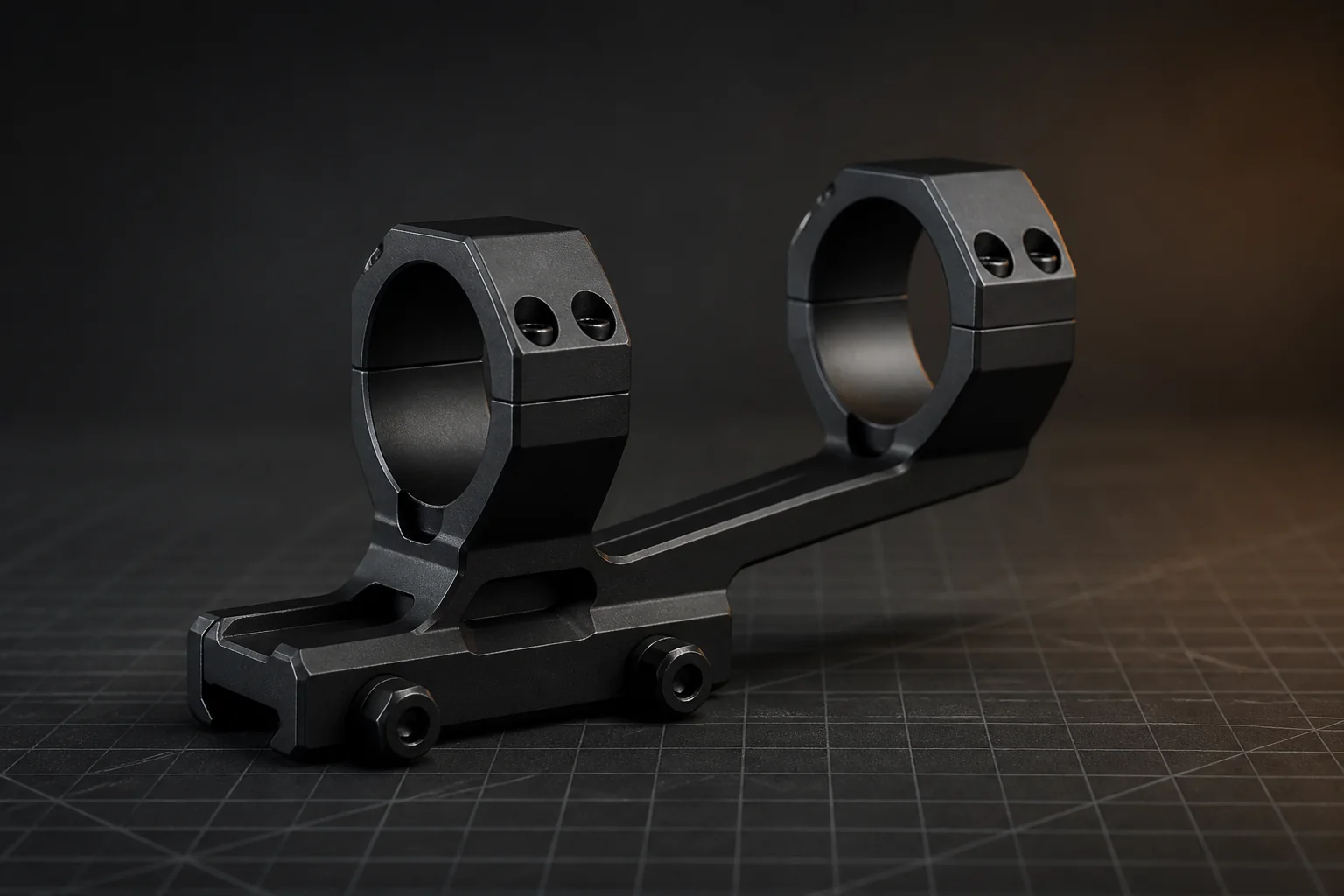
When distributors and OEM partners build a cohesive optic lineup, the cantilever scope mount is one of the highest-leverage components in the catalog. Its offset ring position moves the optical sighting solution forward, solving eye-relief and balance problems that a standard mount cannot. This guide breaks down the engineering and the procurement logic so B2B buyers can specify the right precision optic accessories with confidence.
What a Cantilever Mount Actually Does
A cantilever mount places the optic rings ahead of the base interface on an extended spine. That forward offset lets a long or large-objective sight sit at the correct distance from the shooter’s eye without crowding the receiver. For B2B fleets that mix several optic classes, a single cantilever family can standardize fitment across the range.
Eye Relief: The Reason Most Buyers Switch
Eye relief is the distance at which the full field of view is visible. Magnified optics need more of it; red dots need less. A mismatched standard mount forces awkward head placement, which is unacceptable for professional and outdoor optics users who train or work in repetition. The cantilever design restores a natural cheek weld by shifting the sight forward. See our guide on choosing an optic by intended use for the class-by-class breakdown.
Weight Balance and Optic-Class Fit
Moving mass forward changes how the host platform handles. For heavy or high-magnification units, balanced weight improves stability and reduces point-of-impact shift. This is where the choice of tube diameter matters: our Mounts & Rings overview covers 1-inch, 30 mm, and 34 mm options, and the Optics category explains how objective size drives the ring height you need.
Ring Height, Torque, and Return-to-Zero
A cantilever mount is only as good as its repeatability. Proper ring height keeps the sight clear of the barrel and preserves a consistent sight picture, while correct torque protects the return-to-zero behavior B2B buyers depend on. Our ring-height and return-to-zero guide gives the spec ranges procurement teams should request from any supplier.
Rail Interface: Picatinny and M-LOK
Most cantilever mounts seat on a 20 mm Picatinny base. Confirm cross-compatibility before committing a production run — our Picatinny / Weaver / M-LOK compatibility guide maps the adapter paths, and the Rails category lists the interface standards we support. Use the mount & rail compatibility selector to confirm a clean fit.
Pairing With Stabilization
Cantilever mounts and support systems work as a system. A stable fore-end support reduces vibration and protects zero during transport and field use. Our tactical bipod buying guide and the Stabilization category cover the accessories that complete a repeatable setup.
B2B Procurement Checklist
| Spec | Why it matters | What to request |
|---|---|---|
| Tube diameter | Drives ring size and height | 1″, 30 mm, or 34 mm |
| Offset length | Sets eye relief | Match to optic class |
| Interface | Fitment to host | Picatinny / M-LOK confirmed |
| Torque range | Protects return-to-zero | Documented spec sheet |
| Material | Weight and rigidity | 7075-T6 or aircraft aluminum |
Common Sourcing Mistakes
- Ordering one offset length for every optic class — eye relief differs by magnification.
- Ignoring torque documentation — repeatable zero depends on it.
- Mixing interface standards without a verified adapter path.
Build Your Line With KRS Precision Mounting Systems
KRS supplies tactical mounting systems and precision optic accessories to distributors and OEM partners in 30+ countries, with NDA-backed customization, sample lead times, and documented torque and return-to-zero data. Tell us your optic classes and host platforms, and we will map a cantilever family that fits.
Talk to Our Team
WhatsApp: +86 183 0007 6352 | Email: ddqryp@outlook.com
Request a quote (RFQ) for volume pricing, samples, and private-label options.
Cantilever vs One-Piece vs Two-Piece
Buyers often ask how a cantilever mount relates to one-piece and two-piece designs. A one-piece mount is a single forged body that maximizes rigidity; a two-piece mount splits base and rings for flexibility across receivers; a cantilever is a subtype of one-piece body with a forward offset. For B2B assortments, the practical path is to stock the cantilever variant as the default for magnified optics and keep a standard one-piece option for red dots and prisms. Our scope ring and mount selection guide helps map each optic class to the right body style.
Material and Finish for Longevity
Field conditions punish poor material choices. Aircraft-grade 7075-T6 aluminum delivers the best strength-to-weight ratio for most tactical mounting systems, while hard-anodized finishes resist corrosion and abrasion during transport and repeated attachment cycles. Stainless steel cross-bolts add wear resistance at the interface. When you request a quote, ask suppliers for the alloy grade, anodize specification, and torque ratings — these details separate a consistent precision optic accessory from a commodity part.