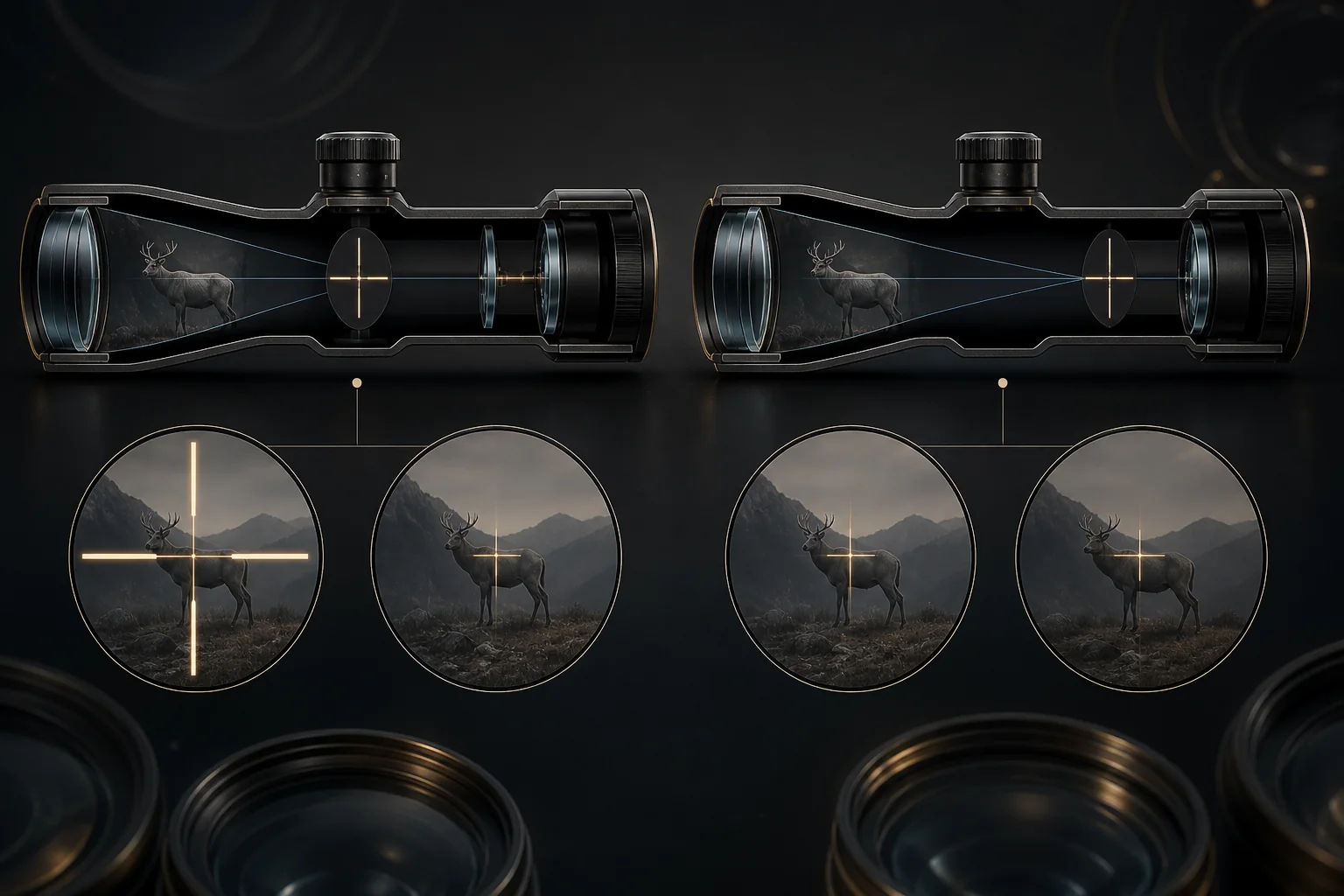
First Focal Plane vs Second Focal Plane: A B2B Scope Reticle Guide
For distributors and importers building a precision optic accessories catalog, the reticle plane is one of the quietest yet most decisive specifications on a product sheet. Buyers rarely ask for it by name, but it drives how the optic behaves at every magnification and how confidently an end user can hold over a target. This guide gives procurement teams a clear framework to match reticle plane to the optics you source and the markets you serve.
What the Two Planes Mean
The focal plane describes where the reticle sits inside the optic. In a first focal plane (FFP) optic, the reticle sits ahead of the magnification lenses, so it grows and shrinks with zoom. In a second focal plane (SFP) optic, the reticle sits behind those lenses, so it stays the same size at every magnification. Both approaches are valid; the difference is about consistency versus simplicity. Our optics category page maps the broader product range these reticles serve.
The Practical Difference Buyers Feel
- FFP — holdover marks and mil/MOA subtensions stay true at every zoom. A shooter can range and hold at any magnification without recalculating.
- SFP — subtensions are only correct at one calibrated magnification (usually the highest). At other zoom levels the marks no longer match the math, so the user must dial to that set power for precise holds.
For importers, this single line on the spec sheet explains why two optics that look identical can behave very differently in the field.
When to Specify FFP
Choose FFP when the end use is long-range precision and the buyer relies on holdovers rather than constant dialing. FFP lets the reticle scale with the image, so a quick hold at 4x is as accurate as one at 16x. Pair FFP optics with repeatable mounting so the zero stays put — our return-to-zero guide covers the mount side of that equation.
When SFP Stays the Smarter Default
For high-volume distributor catalogs, SFP remains the pragmatic core SKU. The reticle never bloats at high magnification, the optic is often lighter and lower cost, and most short- to mid-range users keep the scope near its calibrated power anyway. A clean SFP build also simplifies training for new end users. Our use-case selection guide helps route buyers to the right optic before reticle plane even enters the conversation.
Material and Optical Discipline
Reticle plane is only one layer of a trustworthy optic. The mount, rail, and stabilization around it decide whether the zero survives real handling. For a complete picture of compatible components, review our rail standards and stabilization options, and validate the full build with our mount and rail compatibility selector.
A Practical B2B Sourcing Checklist
- Confirm the dominant end-use range of your top-selling optics before committing to FFP or SFP.
- Standardize SFP as the volume SKU, then add FFP as a specialist line for long-range precision buyers.
- Request reticle-subtension data at the calibrated magnification from the supplier, and verify it against the printed spec.
- Match each optic to a repeatable-zero mount family; our scope ring and mount guide maps the choices.
- Negotiate private-label and MOQ terms up front to protect margin on repeat orders.
Decision Table: FFP vs SFP
| Criteria | First Focal Plane | Second Focal Plane |
|---|---|---|
| Reticle scaling | Scales with zoom | Fixed size |
| Holdover accuracy | True at all magnifications | True only at calibrated power |
| Best use | Long-range precision | Short to mid range, volume |
| Typical cost | Higher | Lower |
| Catalog role | Specialist line | Core volume SKU |
Common Pitfalls to Avoid
- Mixing reticle math with magnification — brief buyers on which power makes SFP subtensions correct.
- Over-specifying FFP for close-range markets — adds cost without field benefit for many distributors.
- Skipping mount repeatability — a great reticle plane is wasted on a mount that drifts; see our optic-type comparison for related choices.
Where Reticle Plane Fits in the Four-Category System
Reticle selection belongs in the Optics discussion, but it only performs as part of a system. Seat the optic on the correct rail, lock it with the right mounts and rings, and complete the build with stabilization such as bipods and rests. Our optical mounting glossary defines every term used above.
Frequently Asked Questions
Q: Which plane should a new catalog start with?
A: Start with SFP in the highest-volume footprints to cover the widest buyer base, then add FFP as a precision specialist line.
Q: Can FFP hurt a short-range optic?
A: It does not hurt, but the added cost rarely pays off for close-range, high-volume markets. Confirm the end use before specifying FFP.
Q: How do I brief a supplier for private label?
A: Share footprint, preferred reticle plane per SKU, subtension data, and target MOQ. Our OEM/ODM capabilities guide outlines the full brief.
Specify Your 2026 Optic Line
Ready to build a reticle strategy for your catalog? Message our team on WhatsApp at wa.me/8618300076352, or open an RFQ at our contact page. We support distributors and importers with private-label precision optic accessories, repeatable-zero data, and flexible MOQ.