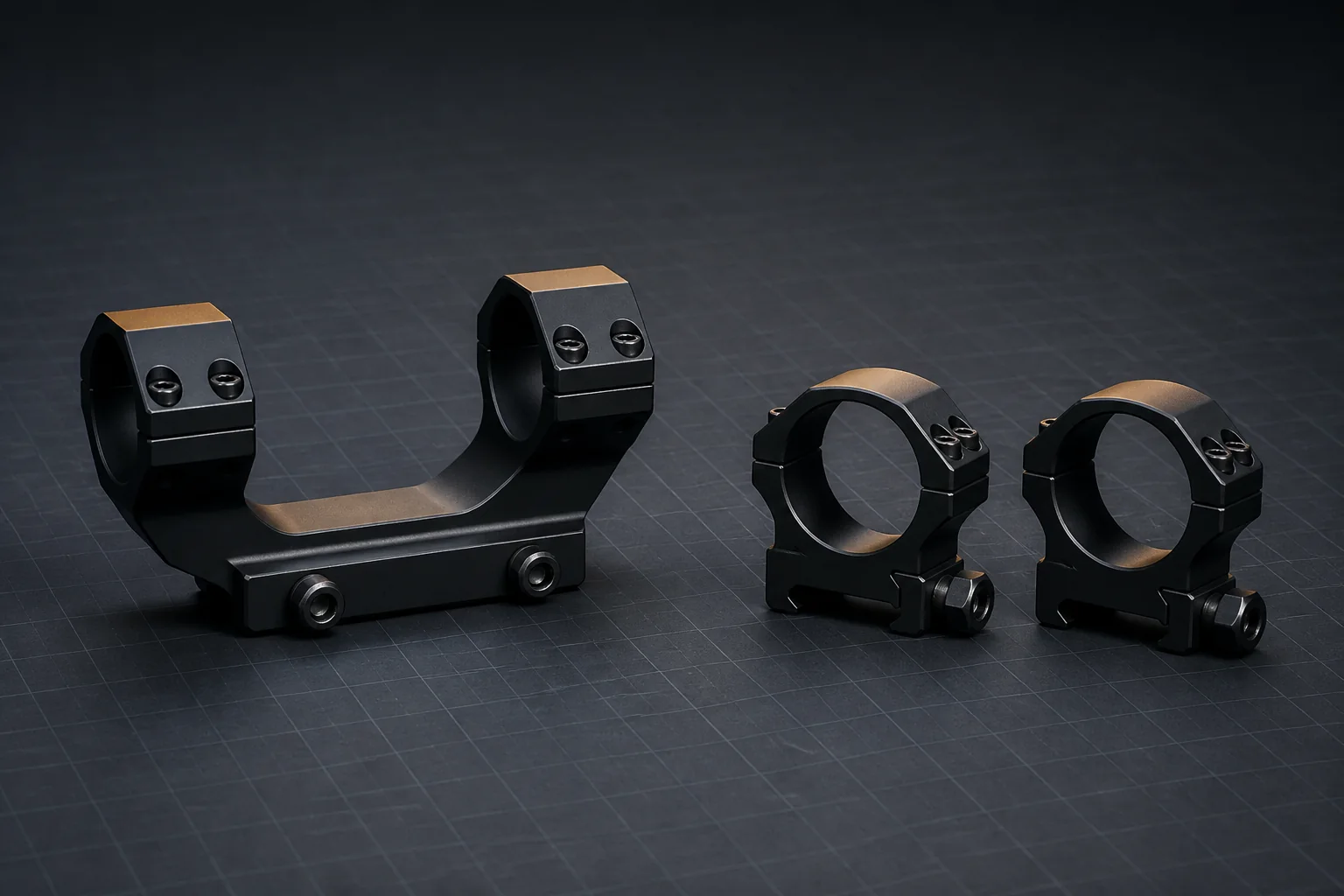
One-Piece vs Two-Piece Scope Mounts: A B2B Buyer’s Decision Guide
For distributors and importers building a precision optic accessories catalog, the choice between a one-piece and a two-piece scope mount is one of the highest-leverage decisions in the Mounts & Rings category. The wrong pick adds returns, slows fulfillment, and erodes repeat orders. This guide gives B2B buyers a clear framework to match mount architecture to the optics you source and the markets you serve.
What Sets the Two Architectures Apart
A one-piece mount is a single extruded or machined body that holds both optic rings on a common base. Because the rings share one rigid structure, alignment stays consistent from installation to installation. A two-piece mount uses separate ring bodies, each secured to its own base section. That separation adds flexibility across rail lengths and lets you pair different ring heights on the same optic.
When a One-Piece Mount Wins
Choose a one-piece design when the priority is repeatable alignment and a short path to a stable zero:
- Heavy or long optics where tube flex must stay minimal under recoil.
- Catalog efficiency — a single SKU covers the most common 30 mm and 34 mm tubes, simplifying inventory and reordering.
- End-user simplicity — installers seat the optic once and torque to spec without juggling two independent bases.
For a deeper look at ring height and return-to-zero behavior, see our guide on scope ring height and return to zero, and our scope ring selection guide.
When Two-Piece Mounts Stay Relevant
Two-piece builds remain the better fit in several B2B scenarios:
- Custom rail footprints — extended fore-ends or split-base receivers where a single body will not seat evenly.
- Mixed inventory — when one ring height does not fit every optic in your range, separate rings let you adapt per SKU.
- Service environments — replace a single ring instead of the whole assembly, cutting downtime and spare-part cost.
Material and Torque Discipline
Material choice trades weight against rigidity. Aircraft aluminum and carbon-fiber-reinforced polymers each have a place; our carbon fiber vs aircraft aluminum comparison breaks down the trade-offs for B2B sourcing. Torque discipline matters more than the alloy:
- Torque to the optic maker’s published spec. Over-tightening can crush the tube; under-tightening lets the optic shift under recoil.
- Use a square-edged torque tool and keep the ring aligned to the tube axis during seating.
- Specify anodized or matte surfaces to reduce glare in field use.
A Practical B2B Sourcing Checklist
- Confirm tube diameter (1 inch / 30 mm / 34 mm) and ring height against your top-selling SKUs.
- Standardize on Picatinny plus M-LOK where the market demands; keep dovetail adapters for heritage and air-rifle channels. Our rail compatibility guide maps each standard to its use case.
- Request repeatable-zero data and finished-anodized surfaces from the supplier.
- Negotiate private-label and MOQ terms up front to protect margin on repeat orders.
- Validate the full setup with a mount and rail compatibility selector before committing to a production run.
Decision Table: One-Piece vs Two-Piece
| Criteria | One-Piece | Two-Piece |
|---|---|---|
| Alignment consistency | High | Medium |
| Fit flexibility | Lower | Higher |
| Serviceability | Replace whole unit | Replace single ring |
| Catalog simplicity | Fewer SKUs | More SKUs |
| Best for | Heavy or long optics | Custom footprints |
Common Pitfalls to Avoid
- Mixing torque specs across rings — keep both sides to the same value.
- Assuming one height fits all — verify clearance against your specific optic and rail.
- Skipping zero validation — a quick bench check prevents field returns.
Where Mounts Fit in the Four-Category System
Mounts & Rings do not operate alone. This Mounts & Rings guide pairs with the right optics, the correct rail standard, and stabilization such as bipods and resting systems. Our optical mounting glossary defines every term used above.
Who Should Standardize First
New distributors get the fastest payback by standardizing one-piece 30 mm and 34 mm mounts as their core line, then layering two-piece options for custom requests. Established importers with mixed legacy optics benefit more from two-piece flexibility and a deeper ring-height matrix. Either path should start from repeatable-zero data so every unit ships ready to seat.
Frequently Asked Questions
Q: Which mount suits a distributor starting a new catalog?
A: Start with one-piece mounts in 30 mm and 34 mm to cover the highest-volume optics, then add two-piece options for custom requests.
Q: Do two-piece mounts hold zero as well as one-piece?
A: They can, provided installers torque both bases to spec and verify alignment. One-piece removes one variable, which is why it leads repeatable-zero programs.
Q: How do I brief a supplier for private label?
A: Share tube diameters, preferred material, finish, and target MOQ. Our OEM/ODM capabilities guide outlines the full brief.
Specify Your 2026 Mount Line
Ready to build a mount program for your catalog? Message our team on WhatsApp at wa.me/8618300076352, or open an RFQ at our contact page. We support distributors and importers with private-label mounting systems, repeatable-zero data, and flexible MOQ.